
Practical guide
Compare van coverage options using the same brief
Hold the message and vehicle fixed while reviewing lettering, partial graphics and broader coverage.
Read the guide: Compare van coverage options using the same briefChicago commercial vehicles & fleets
Arrive with a clear identity on the vehicle that carries your team. Compare lettering, partial graphics and full coverage for your commercial van.
Guaranteed response within 2 hours.Free planning tools and buyer downloads below.
A clear scope before the spend.
Free van coverage comparer below. Use the result with any wrap shop.
More useful project detail
Compare focused lettering, partial graphics and full coverage against the actual van. These guides help turn a preferred look into a clear, body-specific scope.

A visual you can keep
Keep the message fixed while reviewing the included surfaces.
Use the planning example from Chicago Fleet Wraps, download a copy, or read the related project guides.
Practical guide
Hold the message and vehicle fixed while reviewing lettering, partial graphics and broader coverage.
Read the guide: Compare van coverage options using the same briefPractical guide
Record roof, wheelbase, length and door details without relying on a familiar model name.
Read the guide: Identify the right van body before the quotePractical guide
Connect the selected option with panel boundaries, artwork and preparation responsibilities.
Read the guide: Make van coverage approval specific enough to keepPicture the possibilities
Look at the message, the coverage and the working views.
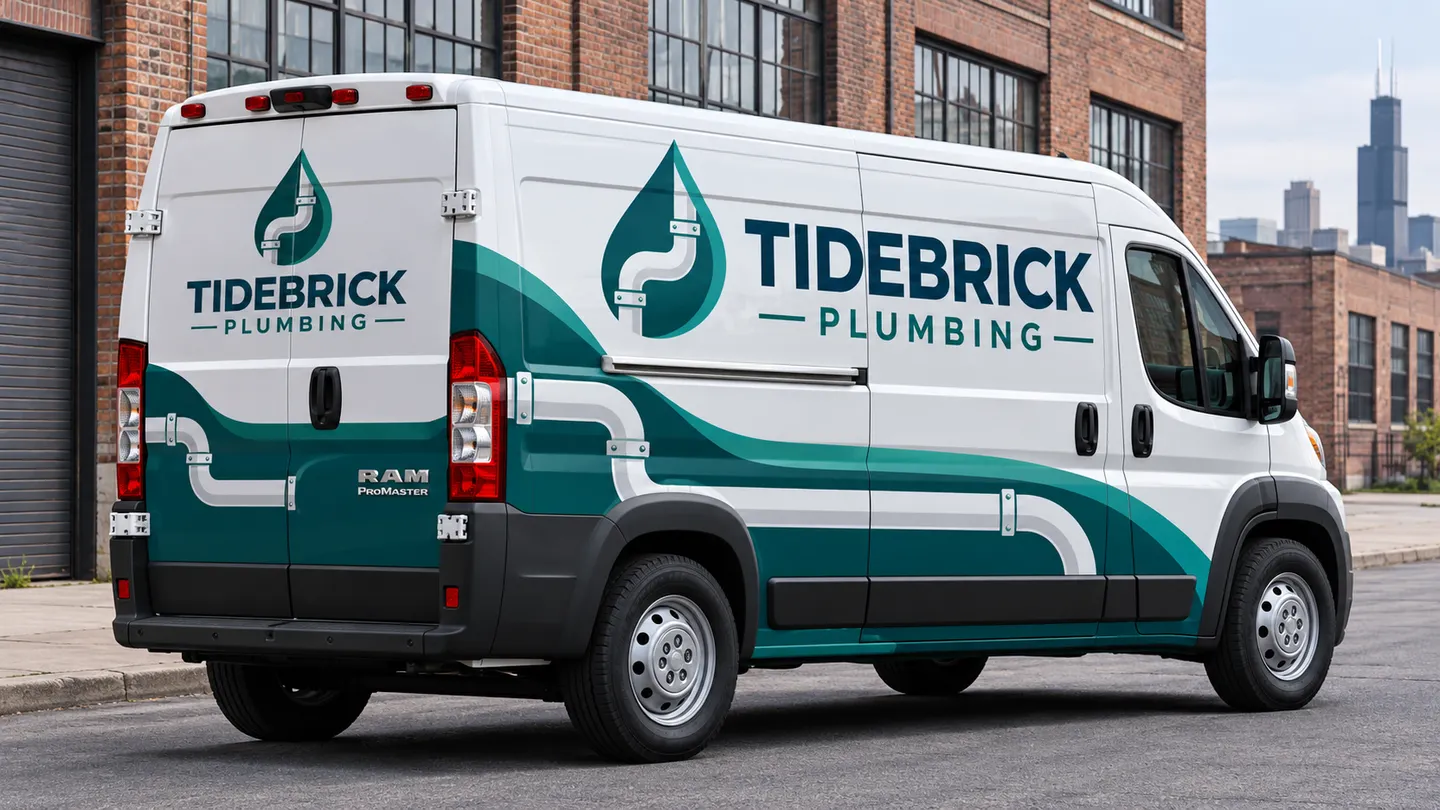
Tidebrick Plumbing is a fictional business. These generated design concepts illustrate ideas to discuss for your vehicles.
Plan the graphics for your vehiclesWhy put your business on a vehicle?
Help a customer connect the arriving van with the business they contacted.
Plan the business name and contact route around doors, handles and useful views.
Compare lettering, partial graphics and full coverage before committing to a scope.
A clear scope before a price
Vehicle size, covered areas, artwork, preparation, existing graphics and the proposed material system all belong in the price discussion.
Useful when the priority is a clear name, service and contact route.
Discuss this scopeCompare the exact panels, message and finish with the full-coverage option.
Discuss this scopeConfirm the included painted panels and any exclusions on the actual vehicle.
Discuss this scopeRequest a price for the actual vehicles and agreed coverage. The free tools below help you compare the assumptions.
Let’s talk vehicles
Tell us how many vehicles you have. We’ll follow up about the vehicles, coverage, design and timing.
Guaranteed response within 2 hours.Know the next step
Guaranteed response within 2 hours. Final project pricing and dates follow review of the scope.
Name, email, phone and vehicle count. Share the project context through the free tool if it is useful.
Discuss the actual vehicles, coverage, artwork, existing graphics and timing.
Check the written scope and vehicle-specific artwork, including the business wording and included surfaces.
Confirm scheduling, preparation, review and the applicable care information.
The free tool
Use the example values to explore, then replace them with your project details.
Use the tool without sharing contact details. Entering a valid email or phone in the inquiry form saves your project entries, filenames, analysis and selected original files, even if unfinished. Original files: up to 50 MB each and 200 MB per batch.
6 × Example work van; details to confirm. Selected direction: Partial wrap.
| Option | Conceptual scope | Tradeoff / review |
|---|---|---|
| Lettering | Logos, short wording and selected contact details | Most paint remains exposed |
| Partial wrap | Designed graphics on selected agreed panels | Exposed paint stays part of the composition |
| Full wrap | Broader designed coverage of agreed body panels | Confirm roof, bumpers, trim and exclusions |
Coverage descriptions are conceptual. Doors, bumpers, roof and other surfaces must be explicitly agreed with the supplier.
Ready to discuss the vehicles? Get fleet pricing. Save your result to use in that conversation.
Free tools for a better buying decision
A 12-page workbook with generic wrap concepts and fillable worksheets for coverage, quote comparison, budget, fleet availability, artwork, proof approval and vehicle records. Use it with any wrap shop.
Fill it in electronically or print it. No email needed.
Take this to any wrap shop
Print it off so you remember to ask. A practical checklist covering scope, materials, artwork, preparation, scheduling, warranty and handoff, plus questions for this project.
Confidence comes from the details
Use these checks when you review a proposal, a proof or a wrap shop. Keep the answers with your project.
Print the wrap-shop questionsSee the tradeoff
Six white service vans can keep exposed paint with lettering, connect selected panels with a partial, or use broader full-wrap coverage.
Illustrative values, not a completed customer project.
6 × Example work van; details to confirm. Selected direction: Partial wrap.
| Option | Conceptual scope | Tradeoff / review |
|---|---|---|
| Lettering | Logos, short wording and selected contact details | Most paint remains exposed |
| Partial wrap | Designed graphics on selected agreed panels | Exposed paint stays part of the composition |
| Full wrap | Broader designed coverage of agreed body panels | Confirm roof, bumpers, trim and exclusions |
Coverage descriptions are conceptual. Doors, bumpers, roof and other surfaces must be explicitly agreed with the supplier.
Leave with something useful
Compare lettering, partial and full coverage side by side. Leave with a scope you can use to request pricing.
Compare my van optionsBuild it from the project details you enter.
Keep the assumptions and open questions visible.
Copy, save or print the result for your next conversation.
Commercial wrap service
Choose service van graphics after reviewing the exact body, door arrangement, windows, equipment, and surface condition. Adapt the brand message to the usable panels instead of forcing a generic layout onto every van. Identify coverage and preparation requirements, then agree installation availability based on the assessed project.
A service van's doors, windows, handles, and body recesses influence where a commercial message can sit clearly. The vehicle may spend the day moving between jobs with tools, racks, or other equipment changing its visible shape. Effective planning starts with the actual van configuration and how the crew uses it. This guide connects those details with coverage, artwork approval, and preparation so the commercial design supports the vehicle's everyday role.
A sliding side door, rear double doors, and passenger-side access can divide the body into very different design areas. Review the normal closed-door appearance and identify where handles, tracks, windows, and gaps interrupt a graphic. Decide which information must remain complete within a single view. The brand can connect across panels without making essential wording depend on a complicated break. Photographs of the actual van are especially valuable when racks, access equipment, or previous body changes make a standard template incomplete. Treat the door map as part of the brief.
A van can carry focused logos, lettering, selected printed panels, or a more extensive wrap. Compare these options against the business message and the available body color. A partial design may use exposed paint deliberately, while broader coverage can connect more of the vehicle into one visual system. Complex contours still require a suitable product and application approach. Ask the proof to show which panels are included and how the design relates to windows and trim. Coverage should support clarity rather than become a goal detached from the message.
Service vans often accumulate residue around handles, lower body areas, and door seams. Those locations need attention during the condition and preparation review, along with old graphics or damaged paint. Give the project an availability window that reflects cleaning, removal if required, and the complexity of the selected coverage. After installation, make the care information accessible to everyone who drives or cleans the van. Ask drivers to report lifting edges or impact damage early so the condition can be assessed rather than allowing a small issue to become an unrecorded fleet problem.
Buy with the questions answered
A partial design can use selected panels and the existing paint color to create a coherent business identity. Compare its actual layout and included coverage with the other options.
Guaranteed response within 2 hours. The next conversation confirms the vehicle details, proposed coverage, artwork, existing graphics and timing so a project-specific scope can be discussed. Sending an inquiry does not reserve an installation date.
Review the covered surfaces, final business wording, vehicle-specific artwork, proposed material system, preparation and removal needs, price exclusions and agreed handoff. The free wrap-shop questions give you a record to use with any supplier.
Before you decide
For project-specific help, use the four-field inquiry form.
Get fleet pricingA sliding door can be included in a commercial layout, but its boundaries, handle, track, and surrounding recesses must be reviewed. The actual configuration matters more than the model name alone. Use a proof that shows these features so the main message is planned around them.
Read the detailed guide: Compare van coverage options using the same brief
It can be considered alongside lettering and fuller coverage. The choice depends on the message, vehicle color, usable panels, and scope. Review a partial design as a complete composition, including exposed paint, rather than assuming the uncovered areas are unrelated to the final commercial appearance.
Read the detailed guide: Compare van coverage options using the same brief
Use the same brand system, but check every body configuration before reusing a layout. Different roof heights, door arrangements, windows, and wheelbases change the usable space. A vehicle-specific adaptation helps keep the main identity consistent without assuming one artwork file fits the entire fleet.
Read the detailed guide: Identify the right van body before the quote
Show those areas in photographs and ask whether they are included in the proposed coverage. Textured plastic can present adhesion limitations, and 3M's vehicle guidance does not warrant applications to it. Do not assume trim can receive the same film treatment as sound painted body panels.
Read the detailed guide: Compare van coverage options using the same brief
Give the business name, primary service and a useful contact method a clear order. Concise fleet messaging helps the most important information stand out.
3M sourceCast films are highly conformable for complex curves. Calendered films are generally used for flat surfaces or simple curves. The exact product specification still governs its suitable uses.
Avery Dennison sourceUnpainted or textured plastic, rubber and silicone need separate evaluation. 3M's vehicle guidance excludes or limits several of these surfaces for the films covered by that guidance.
3M sourceContamination and trapped moisture can undermine adhesion. Seams, crevices and areas beneath seals need attention as part of the final cleaning and drying process.
ORAFOL sourceService van projects can be planned for commercial operators in Chicago, Lincolnwood, Skokie, and Niles, with access and scheduling confirmed for each vehicle. Tell us about your vehicles.